Every Asset Class Finds Its Capital Market: RWAs are coming to Solana

By Inder Preet Singh, VP Product & Tech — D3
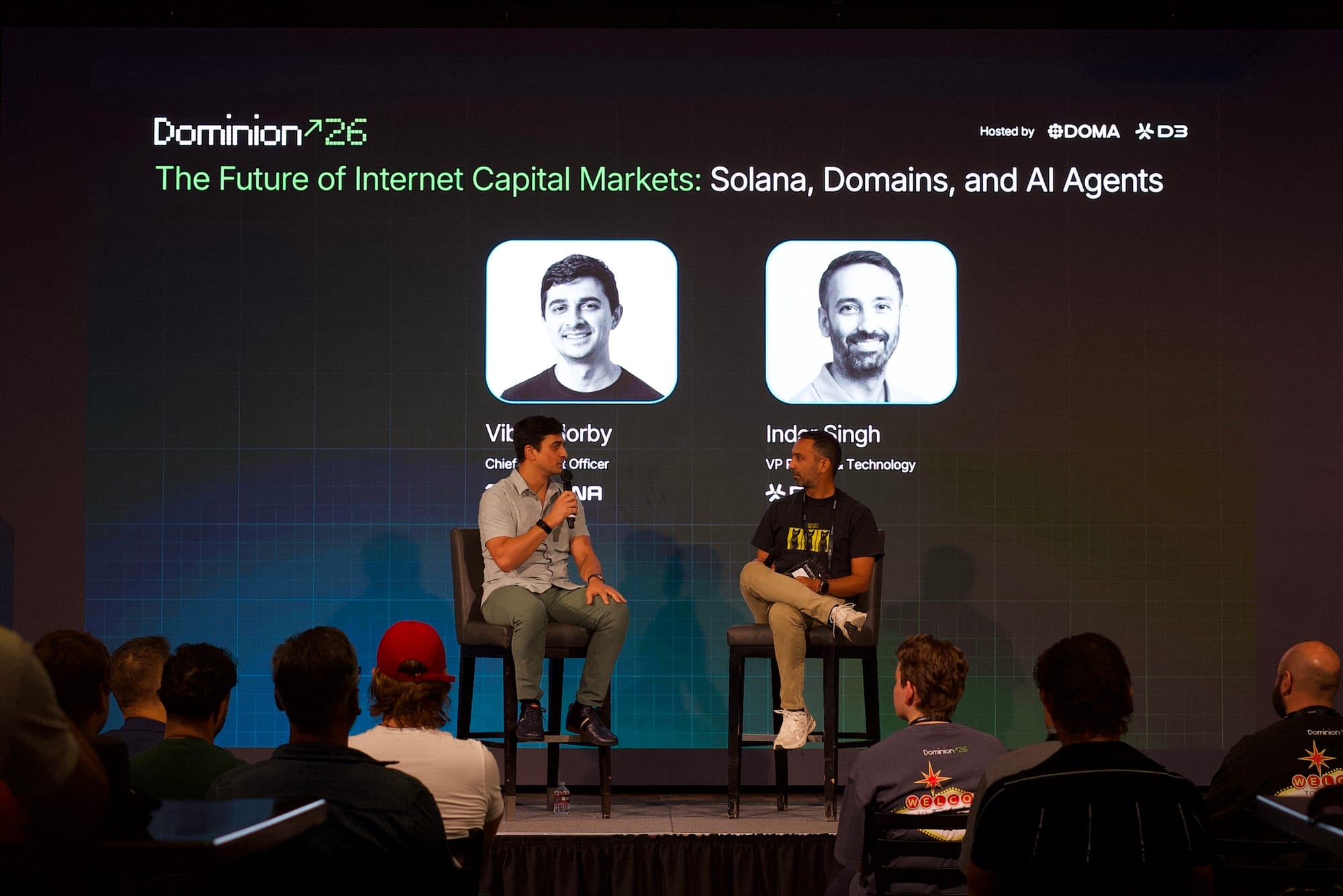
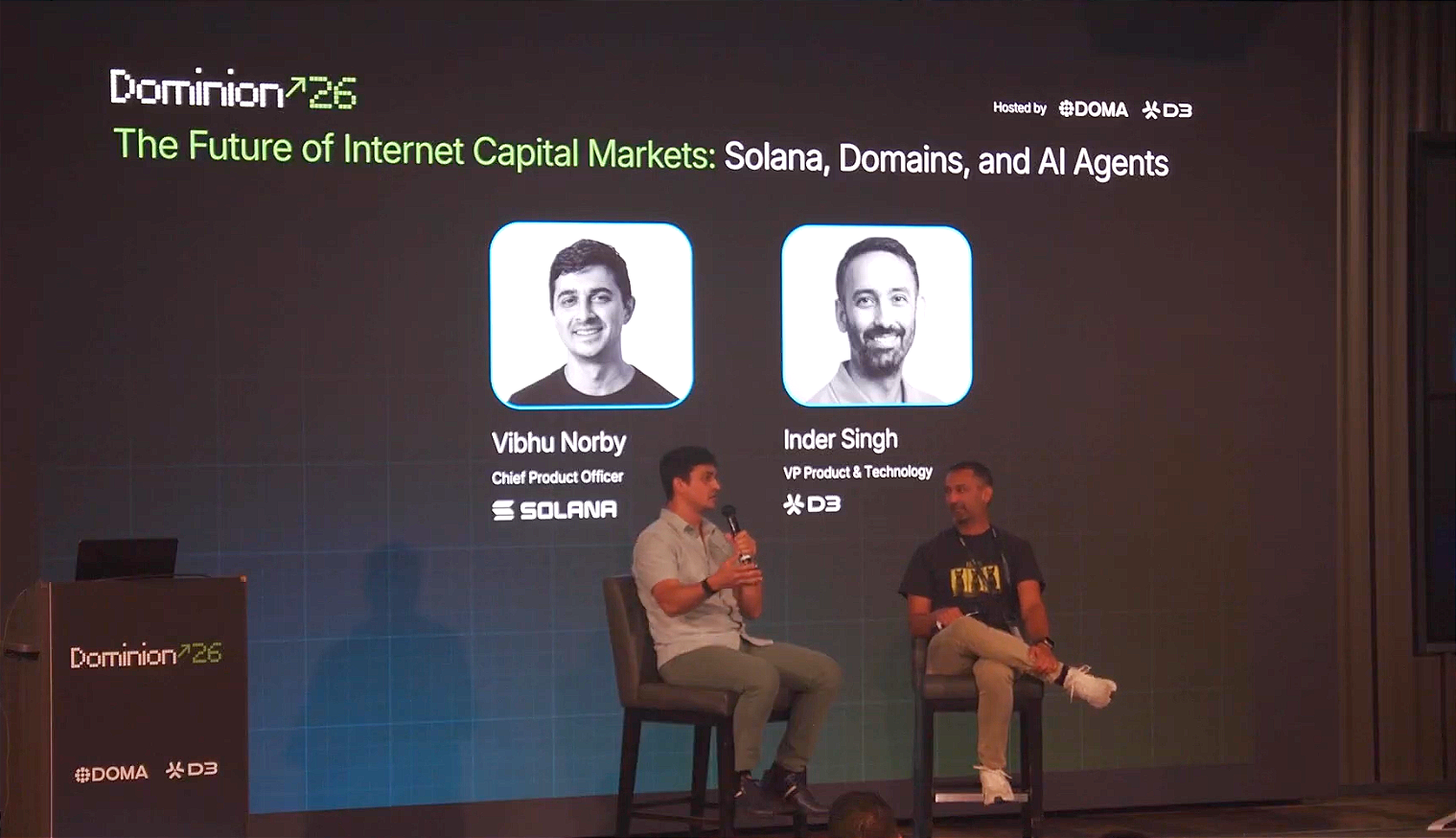
Some conversations confirm what you already believe. Others reshape how you think about what you're building. Vibhu Norby's session at Dominion 2026 — part on-stage interview, part unfiltered conviction — was the second kind.
As Chief Product Officer of the Solana Foundation, Vibhu thinks in markets. Not in tokens or chains or hype cycles — in the structural question of where capital wants to go and what's currently preventing it from getting there. When he talks about domains, he doesn't reach for the language of crypto. He reaches for the language of asset classes.
That framing matters — because it's exactly the thesis behind the Domain Asset Vehicle, the product D3 and Doma are building on Solana. And hearing Vibhu articulate it, unprompted, from first principles, in front of a room of domain industry veterans and Web3 builders, made something click.
Solana Is the Infrastructure. Domains Are the Asset.
Vibhu opened with a number that reoriented the room: Solana handles roughly 100 million transactions per day — more than every other public blockchain combined, twice over. Daily trading volume on Solana now represents 20 to 25 percent of NASDAQ volume. This is not a niche chain. It's financial infrastructure at scale.
And yet, when the conversation turned to domains, Vibhu wasn't speaking as an advocate for Solana. He was speaking as a domain investor — someone who has been buying and selling names since the early 2000s, who still buys .com over anything else, and who understands viscerally why the asset class has never found its market structure.
"Domains should be just as liquid as Anthropic equity," he said. Not as a pitch. As an observation about a structural gap that's been sitting there for decades.
"We have the primitives for internet capital markets — private equities, public stocks, commodities, exotic assets, domains. Now we've got to deliver on the opportunity."
— Vibhu Norby, CPO Solana Foundation, Dominion 2026
The Missing Market Structure
The conversation on stage moved naturally to what comes next — and it landed exactly where D3 has been building. Real estate has REITs. Stocks have ETFs. Domains have had nothing. Not because the underlying assets lack value — the domain market represents over $360 billion in assets — but because the infrastructure to make them liquid, accessible, and composable has never existed.
That's the problem the Domain Asset Vehicle is designed to solve.
Domain Asset Vehicle
Instead of representing one domain, a DAV packages multiple premium domains into one structured onchain asset — bringing existing names into a market built for liquidity, access, and distribution. DAVs don't create a new namespace or replace DNS. They build on top of it.
Vibhu's framing from the stage maps directly onto what DAVs do. When he described the domain industry as an asset class sitting outside the financial system — illiquid, inaccessible, requiring bespoke transactions to change hands — he was describing the exact market failure that a structured onchain vehicle is built to fix.
"The opportunity is bringing net new types of assets on chain," he said. "Pokemon cards, petrified wood, dinosaur fossils — they're all seeing this happen. Domains are sitting right there."
"Domains should be just as liquid as Anthropic.
While it sounds like a joke — it's where we are going.
Every asset will eventually be onchain."
— Inder Singh, VP of Product & Technology, Dominion 2026
AI Changes the Demand Equation for Domains
One of the sharper moments of the session came when the conversation turned to AI — and Vibhu pushed back on the lazy take.
The conventional fear is that AI agents navigating the web on behalf of users will erode the value of domains. Why does a URL matter if a model handles the routing? Vibhu shared that very product, every experiment, every app needs a place to live — and that's not changing. If anything, the explosion of AI-built software is accelerating domain demand, not diminishing it.
The more interesting AI angle he pressed was agentic payments. Solana already holds roughly 65% market share of AI-to-AI payment flows. The infrastructure for autonomous agents transacting on-chain is already being used. And in that world — where agents are acquiring assets, managing liquidity, executing trades — the onchain representation of domain assets isn't a nice-to-have. It's a prerequisite.
"We're building more products than ever. Everything needs a place to live.
I would say I'm blockchain-bullish on domains."
— Vibhu Norby, CPO Solana Foundation, Dominion 2026
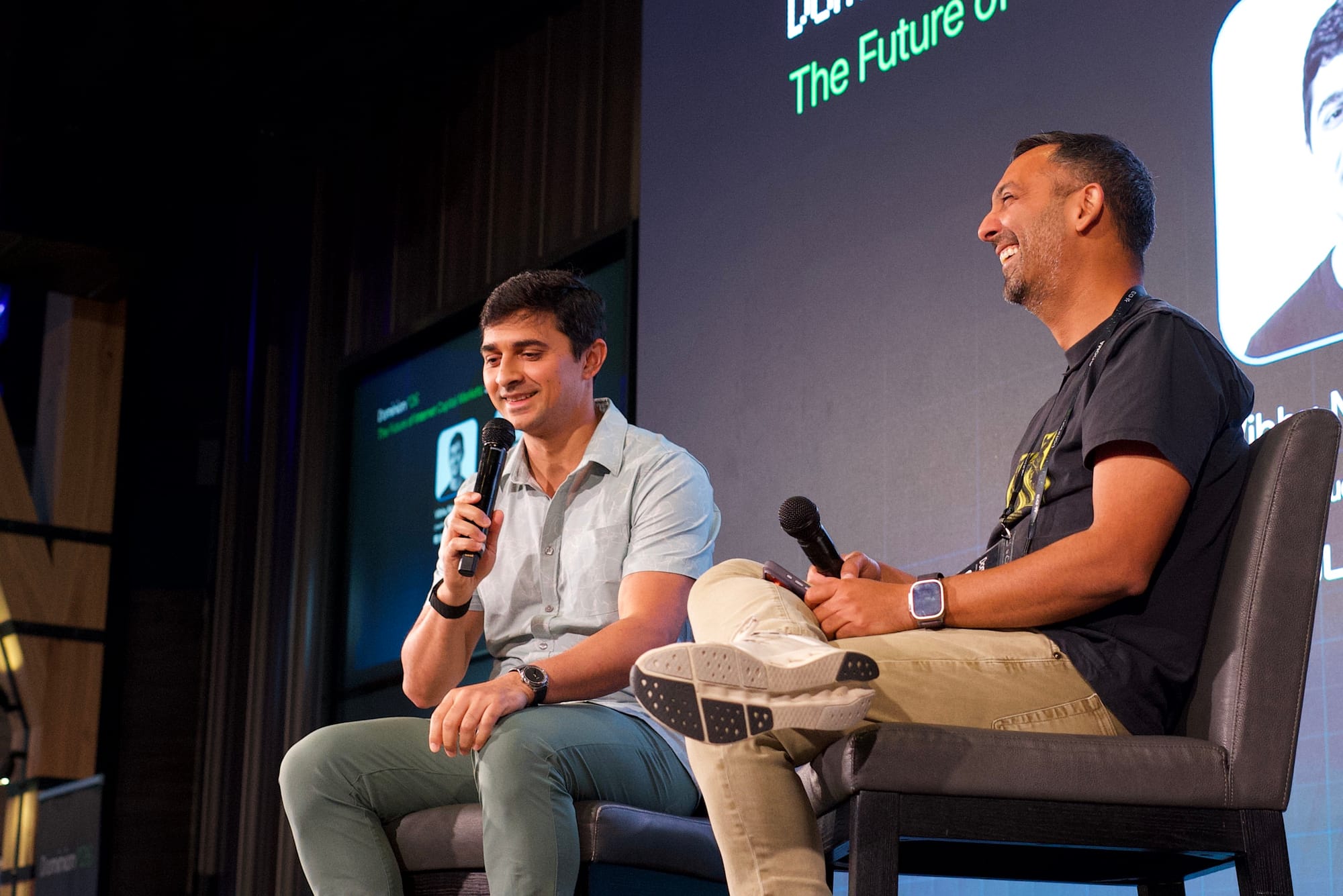
From the Floor
The Hobbyist Who Helped Build a $50B Network
Away from the main stage, the off-the-cuff version of Vibhu is even more interesting. In conversation on the event floor, he described his relationship with domains the way most of the people in that room would recognize: he buys them to use them and they become investments. He's sold around a hundred. He's been doing it since the early 2000s.
That history matters because it grounds his conviction. When Vibhu argues that domains deserve financial infrastructure, he's not speaking from a crypto-native worldview trying to colonize a legacy industry. He's speaking as someone who understands both sides — who has watched premium names sit illiquid in portfolios for years, and who now has access to the infrastructure capable of changing that.
On Solana's cultural stickiness — the question of why capital that arrives tends to stay — his answer was characteristically direct. The Solana community is mercenary capital in the best sense: always looking for the next opportunity.
New products that offer real yield or genuine access to interesting assets find that capital quickly. Domains, packaged correctly, are exactly that kind of asset.
What Comes Next
DAVs are coming to Solana. That's the announcement this session was building toward, and the session itself served as the clearest possible context for why it matters. Domains are not a niche asset class. They are $360 billion in value that has been structurally locked out of the financial system for decades and the combination of DNS-compliant onchain infrastructure, Solana's liquidity base, and the DAV market structure is what unlocks it.
Vibhu's presence at Dominion is a signal of how seriously this opportunity is being taken on the Solana side.
One token. Multiple premium domains. Built for liquidity, access, and the infrastructure layer the domain economy has been missing.
Every asset class eventually finds its capital market.
Domains are next. Coming to Solana.
Follow @domaprotocol on X for launch updates.