What is a DNS Twin and Why Your Primary Name Matters

The internet began with domain names. They were our first digital identities: simple, human-readable labels that replaced IP addresses and made the web usable. Years later, ENS brought that same idea onchain. Instead of long hexadecimal wallet addresses, you could use a name like example.eth to represent your identity in Web3.
A DNS twin connects those two worlds.
A DNS twin is a traditional DNS domain, like example.com or example.xyz, that has been tokenized on Doma and made usable inside ENS. It remains a fully functional Web2 domain, but it also becomes a programmable, onchain identity.
In other words:
Your website domain can now also be your wallet name.
You don’t need to choose between Web2 and Web3. A DNS twin lets one name work in both.
From domains to DNS twins
The ENS x Doma integration has now been live on mainnet for two months. Any DNS domain that is tokenized on Doma can function directly as an ENS name. That means a name like example.com can resolve inside ENS just like example.eth.
Doma works with registries and registrars so that ownership of a DNS domain is represented by a token that is compliant with existing DNS policies and workflows. When that token exists, ENS treats the name as a first class record. You can set wallet addresses, text records and avatars, and the name will resolve wherever ENS is supported.
There is no DNSSEC configuration required for this path. If you already use DNSSEC to import a domain into ENS, that path stays exactly as it is. The tokenized route simply offers a registry native way to bring DNS into Web3.
How it works
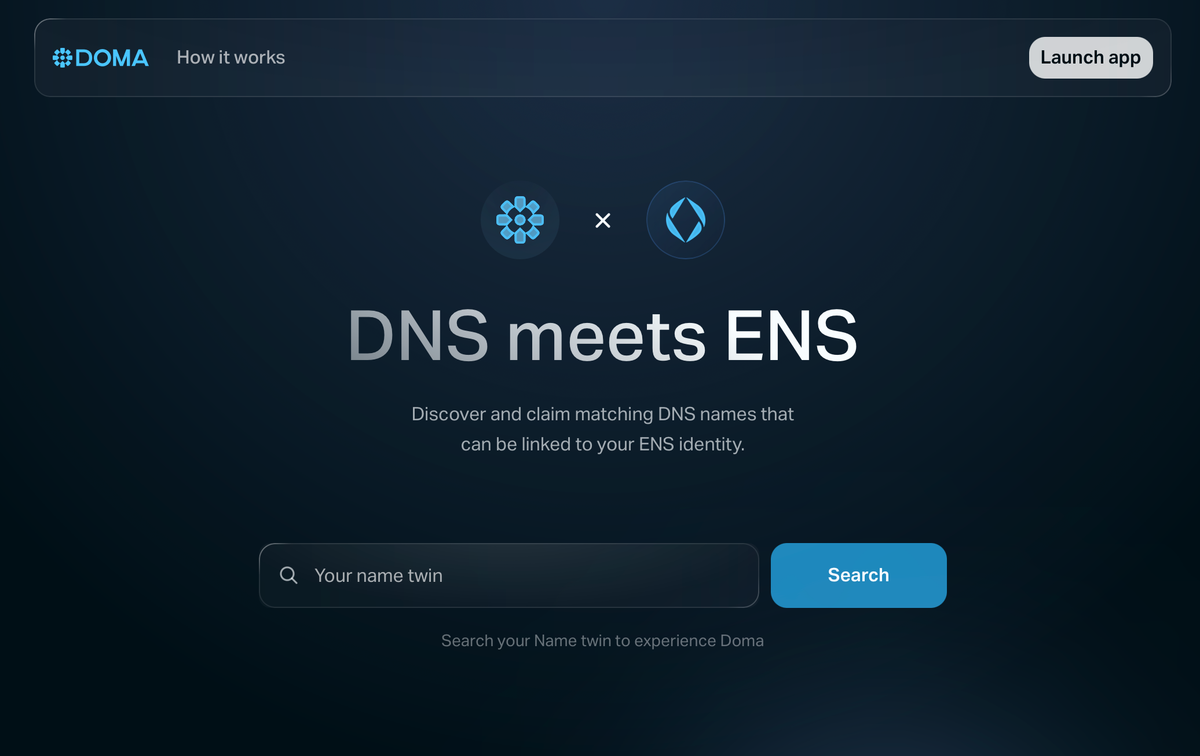
The new Doma meets ENS landing page is built around a simple idea: search for your name twin, connect it to ENS, and use it everywhere.
You move through four steps:
- Connect your wallet
- Find your name twin
- Register your matching domain
- Set your domain as your primary ENS name
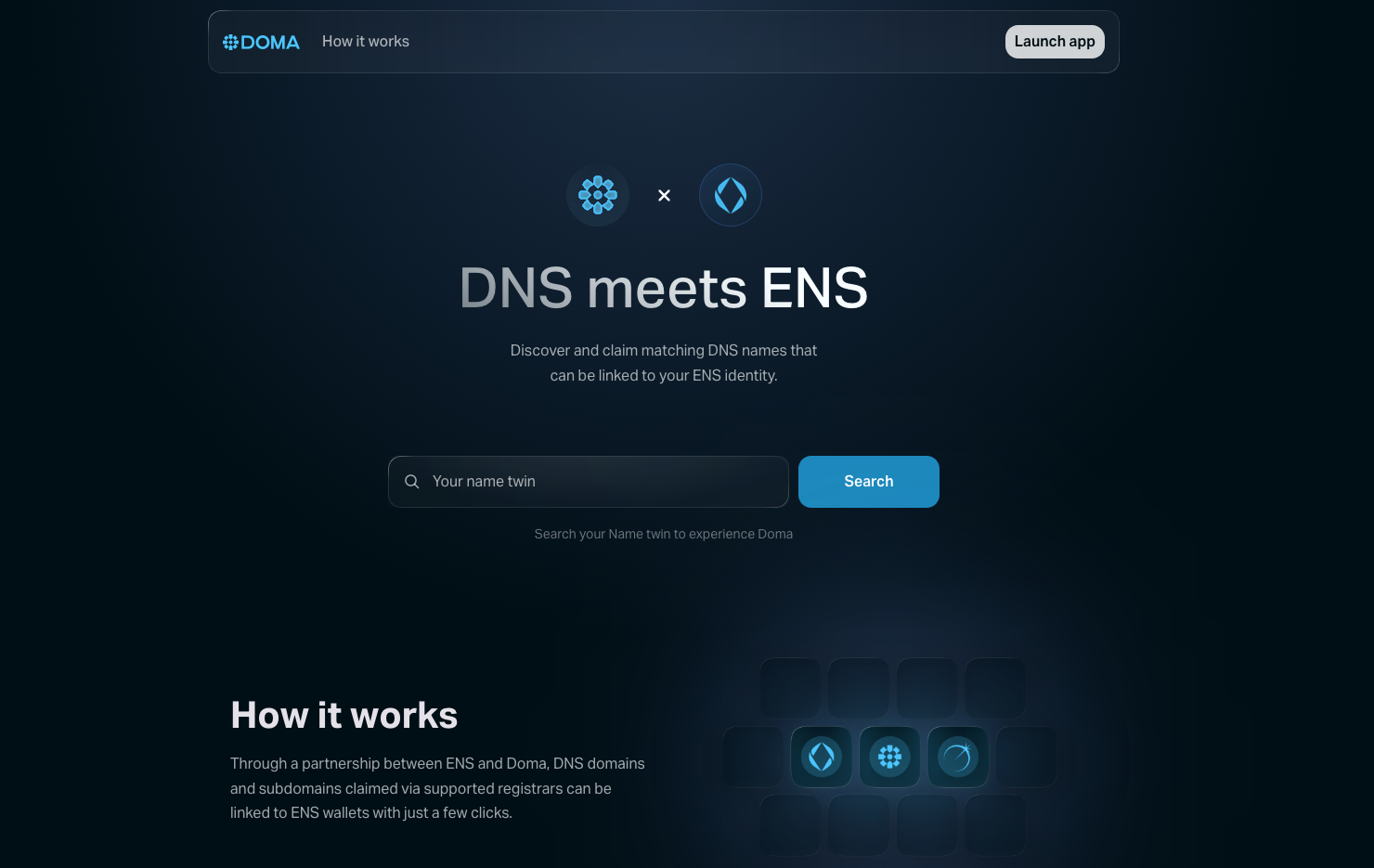
When you connect your wallet, you are choosing the address that will control the DNS twin and its ENS records. When you search for a name twin, Doma looks for DNS names available through supported registrars that match the identity you want.
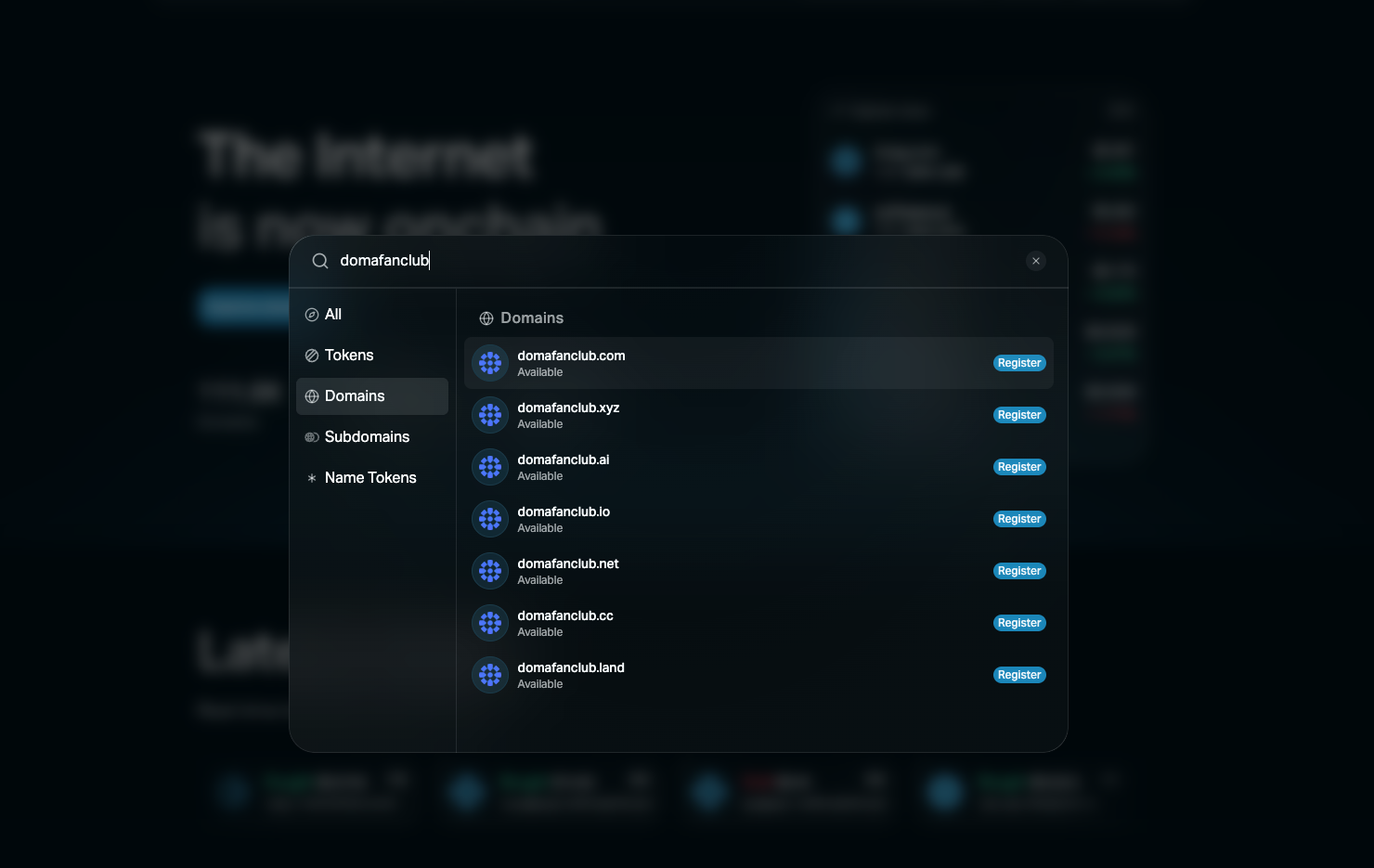
If the domain is available, you can register and tokenize it in a single flow. If it is already tokenized, you can acquire it through Doma’s marketplace surfaces. In both cases, once the token is in your wallet, the domain is ready to act as an ENS name.
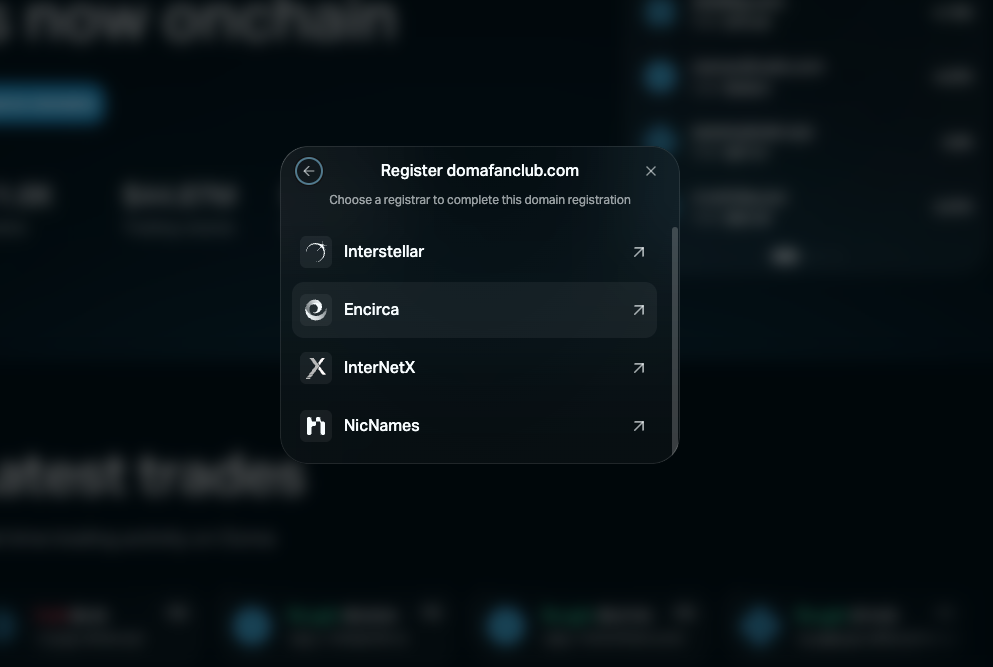
From there, Doma guides you to set your DNS twin as your primary name.
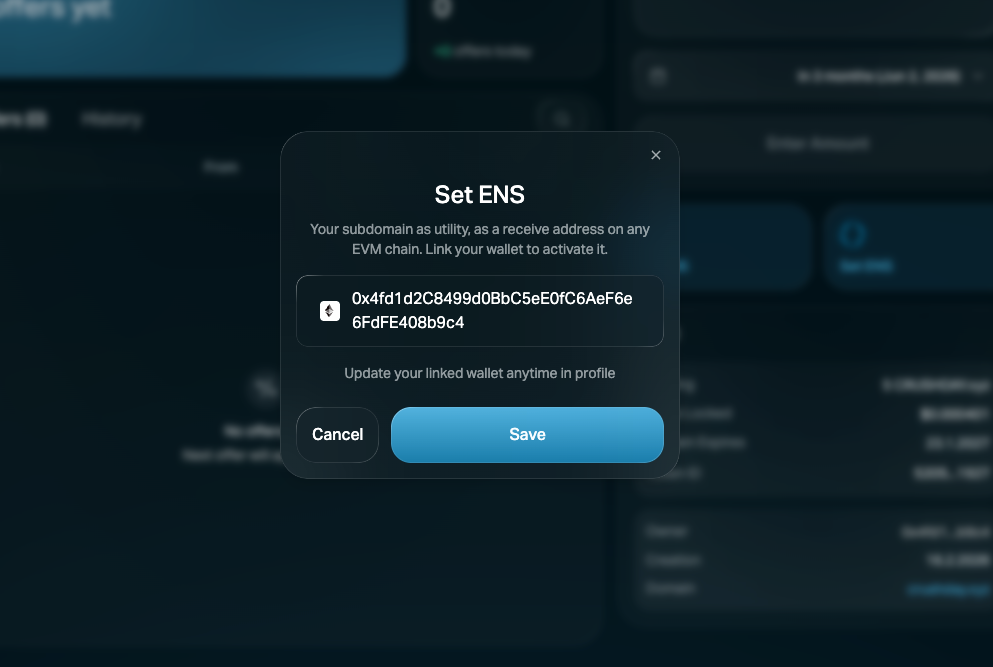
What primary names do
Primary names are how ENS links an address back to a single human readable name. Forward resolution maps a name to an address. Reverse resolution maps an address to a name. A primary name is the record that makes those two directions agree for a specific address.

When a wallet or app wants to show a name for the address you connected, it looks up the primary name. If it finds a valid record, it displays that name. If it does not, it shows the address itself.
Setting a DNS twin as your primary name tells every ENS aware interface that your DNS identity is the one to show by default. If you set example.xyz as the primary name for your address, that is what appears next to your activity instead of a string of hex characters.
Why primary names matter for DNS twins
Primary names are not a cosmetic detail. They are how a name becomes your default identity onchain.
When your DNS twin is configured as your primary name:
- Your DNS brand is what people see when they interact with your address across ENS integrated wallets and apps.
- You avoid splitting attention between one name for DNS and a different name for ENS. You have a single, familiar label.
Your identity can move with you across L1 and L2 networks, since ENS also supports L2 Primary Names.
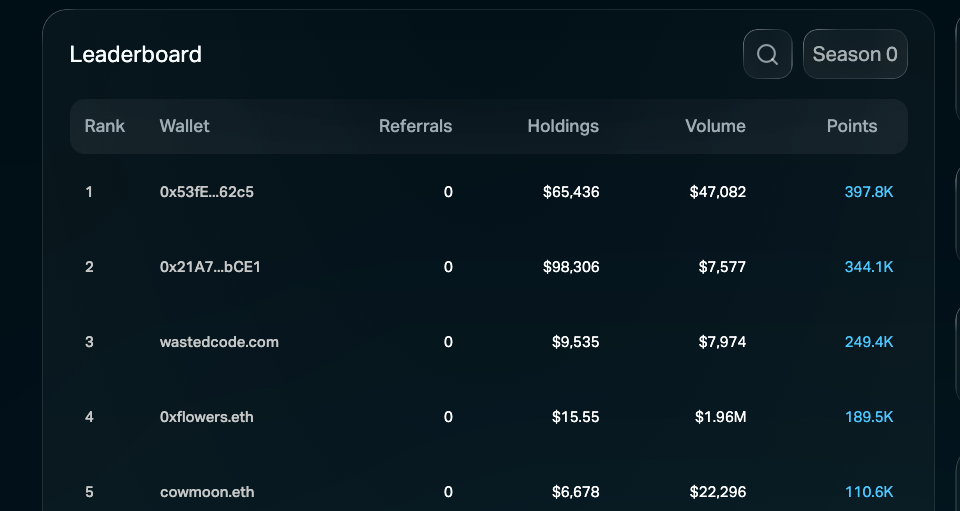
If you already use a .eth name as your primary, you now have a choice. You can keep your .eth primary and add a DNS twin for specific use cases, or you can make the DNS twin primary and keep .eth as a secondary identity. ENS supports both models.
Mapping ENS records to your DNS twin
Once you register your DNS twin, you can manage it the same way you would manage an ENS name.
You can:
- Set ETH and multicoin addresses
- Add text records for profiles, links and metadata
- Attach an avatar for visual identity
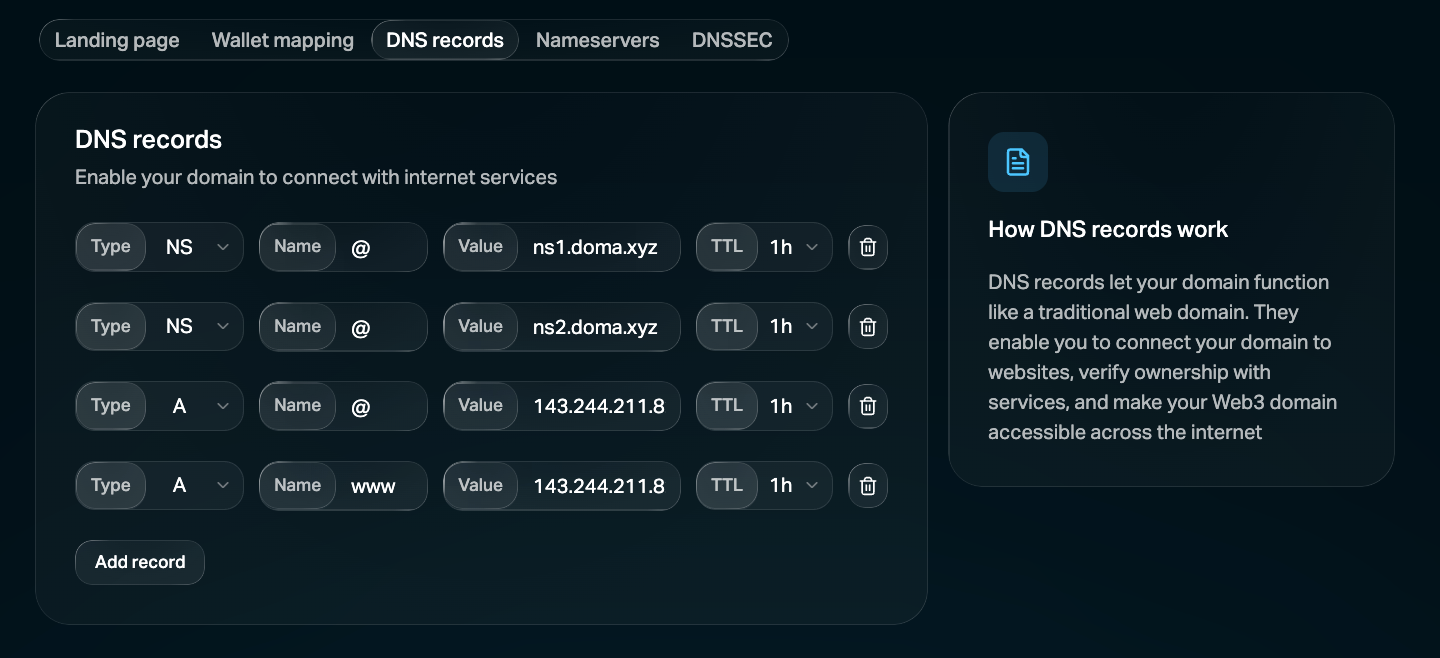
Those records are chain agnostic at the ENS level. A single DNS twin can reference addresses on Ethereum mainnet, Base, OP Mainnet and other supported networks while staying consistent for users. Apps only need to support ENS resolution. They do not need to know whether the name is .eth, .com, .ai or .xyz.
For domain owners who already keep their DNS and brand presence up to date, this is a direct way to reuse that work in Web3.
Why this matters for registries and registrars
A DNS twin is a standard DNS domain, like example.com, that has been tokenized on Doma so it can function both as a traditional web address and as an onchain identity. For registries and registrars, this is not a new naming system and it does not replace DNS. It adds new capabilities to the names you already operate.
Doma’s model keeps DNS resolution and policy at the registry and registrar level while adding a token layer that is compatible with DeFi, identity and other onchain use cases. ENS support makes those tokenized domains usable across hundreds of apps and wallets with no custom integration work.
That makes DNS twins a practical path for:
- Turning premium domains into programmable assets
- Letting customers treat domains as identities in Web3
- Experimenting with DomainFi models without disrupting established DNS workflows
Live on mainnet
The first ENS x Doma integration was shipped on a public Ethereum testnet in October 2025 and moved from public Ethereum testnet to mainnet in early 2026. Since then, the architecture has been independently reviewed, validated with ecosystem partners, and operating in production. Today, tens of millions of DNS domains are eligible to be tokenized under Doma, without changing how they resolve on the traditional internet.
This is not a wrapper or a workaround. It is infrastructure designed to align with existing DNS policies while extending domains into programmable, onchain environments.
Today, you can visit the Doma Meets ENS, connect your wallet, find your DNS twin and set it as your primary ENS name in a single session.
From that point forward, the domain you already own, the one printed on business cards, websites, and investor decks, becomes the name that wallets, apps, and protocols display by default.
Your DNS domain does not stop being a web address. It becomes your onchain identity.